

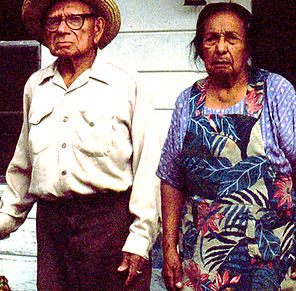
Bob's Grandpa Oliver “Chief” and Grandma Esther Pahdopony
Are you growing older?
Or becoming an elder?
Those are not the same thing.
By elder we don't mean elderly. We mean someone whose life experience has created wisdom worth passing on — and that can happen at any age.
Everyone who lives long enough grows older. But not everyone becomes someone others trust, seek out, and feel genuinely met by. Not everyone becomes a person whose presence itself is useful to the people around them.
There's a question that arrives at a certain point in life. Not loudly, but persistently. A growing sense that what you've been through carries something.
You find yourself drawn toward younger people — wanting to spare them the long way around, wanting to offer something of what you've earned.
And a quiet question begins to surface:
Is what I've lived actually becoming something I can offer?
We live in a culture that has largely misplaced its elders. Moved them to the side. Stopped calling on them.
And the cost of that is visible everywhere — in the loneliness of the young, the isolation of the old, the absence of anyone to hold the invisible world open for the rest of us.
There is a vacancy in most communities.
You may be exactly what's missing.
We used to have a name for people who learned to fill that role. We called them elders. Not simply someone older, but someone whose life had become useful to others. Someone who carried what they'd lived in a way that could actually reach another person.
That role has largely disappeared from modern life. And its absence is felt, even when we don't have words for it.
This webinar is an evening in that territory.
What we'll explore together

In this live session, I'll guide you into a way of understanding your own life that most people were never shown.
You'll begin to see more clearly what your experiences have actually given you, and how they might begin to take shape as something you can carry and offer.
Bob and his Adopted Father, Moses Starr
Together we'll explore:
-
What cultures that still honor elderhood understand about wisdom that ours has largely forgotten
-
The difference between getting older and becoming an elder, and how to recognize which is happening in your own life
-
A simple way of working with your experience so it begins to take on meaning and direction
-
Wisdom as information versus wisdom as presence — and why only one of them can truly help another person
At the end of the session, I'll briefly introduce Becoming a Wisdom Keeper, my upcoming four-week course for those who want to go deeper.
There will be time for questions. I want to hear what's alive for you.
This is not a lecture. It's closer to what I'd call a recognition experience.


About your guide — Bob Vetter
I'm a cultural anthropologist who has spent decades in close relationship with Native American elders and traditional healers. Today I help people understand what their life has given them — and how to carry it in a way that can genuinely serve others.
Over four decades, I came to know elders from many tribes across Oklahoma. I had the honor of being adopted into families across four nations, received as a grandson by Oliver Pahdopony, the last surviving medicine man of the Comanches, and developed close bonds with Kiowa, Caddo, and Cheyenne elders. I also trained for many years in Curanderismo, the traditional healing system of Mexico, eventually becoming a practitioner and teacher in that lineage.
What I expected to learn from these elders was what they would say. The teachings, the stories, the accumulated knowing.
What I learned was something harder to put into words.
It was far less important what they said than what I felt in their presence. There was a quality of attention, a patience, a way of holding another person that made you feel seen, sometimes for the first time. When they spoke, it came from a life that had been lived, suffered, and integrated.
One Kiowa elder, Richard Tartsah, told me the first time we met that he had been expecting me — not because anyone had called, but because he had dreamed it. He later chose to write his family's spiritual history with me because, he said, the stories had visibly touched me. That book became Big Bow: The Spiritual Life and Teachings of a Kiowa Family.
Years into my visits with Oliver Pahdopony, his daughter told me that her father considered me his grandson and had given me a name. The name translated to Storyteller.
I had never told Oliver a story. I had only ever asked him to tell me his.
What I've come to understand is that Oliver wasn't describing what I was. He was pointing toward what I carried — something I hadn't yet fully learned to offer.
A name given before it was earned is not a compliment. It's an invitation.
I think many people reading this carry something similar. A life that has given you more than you've yet found a way to pass on.
Over time, I came to recognize that the work the elders did for me is the same work I now do for others — and teach others to do.
This evening is part of that effort. My upcoming course, Becoming a Wisdom Keeper, is the foundation of that work for those who want to go deeper.
.png)
What others have experienced
“Bob guides everyone with patience, kindness, and humility. What impresses me most is his great humility despite his vast knowledge. I was able to see the results of the work — changes visible both to me and to my loved ones.”
— Céline Rossini
“Bob's teachings have allowed me to become who I am. The path of the Wisdom Keeper leads me to be the wounded healer that I have always been — but never dared to embrace. I now share my medicine with those who need the kind of support I can offer.”
— ValOo
“Bob's teaching style is kind, understanding, encouraging, and respectful. He meets people exactly where they are in their journey. The skills and perspectives I've learned from Bob have added depth to my own healing practice and opened new avenues for me to reach and help more people.”
— Melanie Rimkus, Alden, NY
This may be for you if:
-
You've lived through experiences that shaped you in ways you're still understanding
-
You sense you have something meaningful to offer, but don't yet know how to share it
-
People are beginning to come to you for something they can't quite name
-
You feel drawn toward a deeper sense of meaning, usefulness, and contribution
You may already be walking this path, even if you haven't fully named it yet.

Bob with Ella Fay Horse (née Big Bow), a Kiowa Native American artist and member of the renowned Big Bow family, whose works are held in the Gilcrease Museum in Tulsa, Oklahoma.
All registrants receive access to the replay.
This evening is open to anyone who feels the call — whether you're in your thirties or your seventies. Elderhood is not about age. It's about what you've lived and what you're ready to offer.
The question isn't whether you've lived enough. The question is whether you're ready to recognize that your community may already be waiting for you.